Stocks you already hold on Binance convert to bStocks 1:1, free
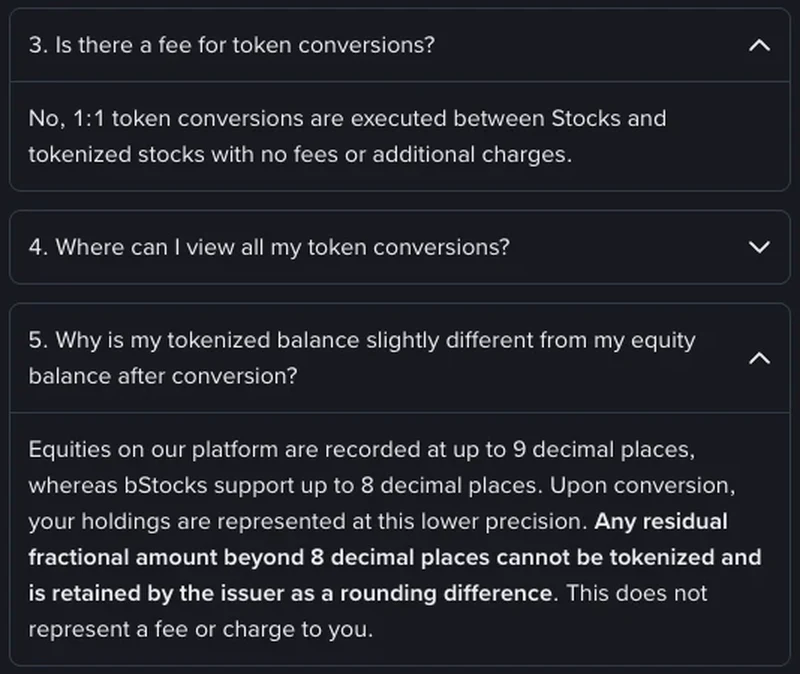
Stock positions held on Binance can be turned into the corresponding bStocks at 1:1 through the token conversion feature, with no fee and no extra charge. The conversion is provided by Nest Trading Limited and is normally available around the clock.
The reverse direction is also 1:1 and also free, with one added condition: before bStocks can be converted back into stocks, you have to open a stock account on Binance and accept the relevant terms. Decimal places are what can leave the two amounts unequal. Stocks are recorded to at most 9 decimal places and bStocks to at most 8, so on the way to bStocks any fraction beyond the eighth place does not carry over and is retained by the issuer as a rounding difference.
Throughout this article, stocks means the stock positions you hold on the Binance platform; Binance's help pages call them simply stocks and speak of a stock account. bStocks are BEP-20 tokens on BSC. The disclaimer in Binance's bStocks FAQ states that they are not shares and that holding them does not amount to directly owning shares in the listed company concerned.
Three ways to get bStocks and the two conversion directions compared
Tokenizing a stock buy order as you place it, converting stocks you already hold at 1:1, and buying directly on spot all end with bStocks in the account. The second route run in reverse is the conversion from bStocks back to stocks.
| Situation | What you start with | Where and how | Fee | When it is available | Conditions and limits |
|---|---|---|---|---|---|
| Tokenize at order time | A supported cryptocurrency, for example USDC, USD1, USDT, U or BNB | Place a buy order for the underlying stock, switch on the option that tokenizes that order, then confirm the purchase | Fees are among the listed order conditions; the help page gives no figure | Once the order is accepted, executed, settled and processed, it shows in the account as the corresponding bStock | Eligibility checks, availability of the underlying security, market conditions, taxes, withholding tax, rounding and the applicable legal documents |
| Existing stocks to bStocks, 1:1 | A stock position on Binance | Select the asset to convert, start the token conversion, check the details in the confirmation window, then confirm | Free | 24/7; may be paused during corporate-action processing windows or technical maintenance | Any fraction beyond 8 decimal places is retained by the issuer |
| Buy on spot | The same as for buying any other cryptocurrency | In the bStocks section of the spot market, choose a token and follow the on-screen steps | Not stated: Binance's Q&A on buying on spot does not cover fees, which is not the same as free | 24/7 | — |
| bStocks back to stocks, 1:1 | bStocks in your account | Select the asset, start the conversion, check the details in the confirmation window, then confirm | Free | Same as the token conversion above | The stock account must be opened and the relevant terms accepted first |
For someone who holds nothing yet and only wants bStocks, either tokenizing at order time or buying on spot works. The first goes through a stock buy order and appears in the account as a bStock only after the order has been executed and settled; the second works like buying any other coin and is open around the clock. Anyone who already holds stocks can use the 1:1 token conversion, with no need to sell and buy back. For a holding that is headed for an on-chain wallet, our understanding is that it needs to be in bStocks form; the questions at the end explain why.
Tokenizing a stock order versus buying bStocks on spot
When a stock is bought with a supported cryptocurrency, the order can settle directly as bStocks. On the buy order, the option that tokenizes that order is switched on before the purchase is confirmed. Once the order is accepted, executed, settled and processed, the exposure is reflected in the Binance account as the corresponding bStock. Binance lists eligibility checks, availability of the underlying security, market conditions, fees, taxes, withholding tax, rounding and the applicable legal documents as conditions. The cryptocurrencies it gives as examples for payment are USDC, USD1, USDT, U and BNB.
To avoid switching the option on order by order, the additional settings menu has a setting that tokenizes all orders. With it on, new orders for every underlying are tokenized, and it can be switched off again in the same menu. The wording refers to new orders, so stock positions already held fall under the token conversion in the next section.
Buying on spot works like buying any other cryptocurrency: in the bStocks section of the spot market, pick a token and follow the on-screen steps, 24/7. Our step-by-step guide to buying bStocks with Binance and withdrawing to a Web3 wallet follows that route from purchase to wallet.
How to convert stocks you already hold into bStocks
A stock position converts to bStocks without being sold, inside the token conversion feature:
- Select the asset you want to convert and start the token conversion.
- A confirmation window shows the details of this conversion. Read each item before confirming; your original position size is a useful figure to compare against.
- After confirmation the conversion goes through at 1:1 with no fee. If the position runs to a ninth decimal place, the amount received drops that last digit, for the reason explained further down.
Token conversion is generally available around the clock and may be suspended for a time during corporate-action processing windows or technical maintenance. The pause table in our article on why your wallet, BscScan and Binance don't match shows which corporate actions stop which functions.
Converting bStocks back to stocks needs a Binance stock account first
Converting bStocks back into stocks follows the same steps as the forward direction: select the asset, start the conversion, review the details in the confirmation window, then confirm. The one addition is a prerequisite. Binance's help page states that converting tokens into the corresponding underlying asset requires opening a stock account first and agreeing to the relevant terms.
Converting back therefore depends on two things being in place: the stock account is open, and the terms have been accepted. How the account is opened is not spelled out on that page.
The stock account in this section is the one inside the Binance platform. Our article on whether you need a brokerage account to buy tokenized US stocks answers that no brokerage account is needed, and the account meant there is one with a traditional outside US-stock broker. Buying bStocks alone does not call for an outside brokerage account. Converting bStocks back into stocks held on Binance does call for a stock account opened on Binance.
Why the ninth decimal place disappears after converting to bStocks
The conversion is 1:1, yet the amount can differ by a sliver, because the two sides record different numbers of decimal places. Binance's explanation runs as follows: stocks on the platform are recorded to at most 9 decimal places, and bStocks support at most 8. After conversion the holding is expressed at the lower precision, and any fractional remainder beyond the eighth decimal place cannot be tokenized and is retained by the issuer as a rounding difference. The same answer adds that this does not constitute a fee or charge collected from you.
Suppose a stock position of 0.123456789 shares, exactly nine decimal places, is converted 1:1 into bStocks:
| Item | Amount | Where it comes from |
|---|---|---|
| Stock position before conversion | 0.123456789 shares | 9 decimal places |
| bStocks received | 0.12345678 tokens | Only 8 decimal places are kept |
| Rounding difference retained by the issuer | 0.000000009 shares | 0.123456789 − 0.12345678 |
The remainder is never more than a single digit in the ninth decimal place, so it stays below 0.00000001 shares. If a stock were priced at $1,000 a share, 0.000000009 shares would correspond to $0.000009. A position that has 8 decimal places or fewer, such as 5.25 shares, converts to 5.25 tokens and leaves no remainder.
Converting back to stocks should not produce a remainder of this kind: bStocks carry at most 8 decimal places and stocks can record 9, so the digits fit (the answer itself addresses only the stock-to-bStocks direction).
Where to check your bStocks conversion records
Tokenization and conversion records are listed in the stocks tab of the transaction history inside the token conversion feature, and Binance says every tokenization and conversion record can be viewed there. To see where a fraction went, compare the converted amount shown there with your original stock position. A gap confined to the ninth decimal place is the rounding difference described above. A larger gap has a cause other than precision, and you can take that record to Binance customer support.
The rules above are taken from two pages in Binance's Help Center, read in September 2026: the FAQ on bStocks deposits, withdrawals and conversion, linked here in English, and the bStocks FAQ, linked in Simplified Chinese. The comparison table, the notes on which route suits which starting point and the decimal example are our own work, and none of it is investment advice.
Conversion fees and the withdrawal network
Is there a fee to convert stocks to bStocks on Binance?
No. The 1:1 token conversion between stocks and bStocks carries no fee or extra charge in either direction. The fraction beyond the eighth decimal place that stays with the issuer on the way to bStocks is also, by Binance's description, not a fee or charge collected from you.
Can stocks held on Binance be withdrawn straight to an on-chain wallet?
Our understanding is that they have to be converted to bStocks first. Binance's deposit and withdrawal notes describe withdrawals only for bStocks: they run on the BSC (BNB Smart Chain) network alone, are standard BEP-20 tokens and can be withdrawn to BSC-compatible wallets. That stock positions cannot be withdrawn directly is our reading of those notes. After withdrawal, transfers remain subject to transfer restrictions, smart-contract controls, sanctions screening, eligibility rules and applicable law.